Oil prices fall sharply on Iran deal, but whether they go much lower ‘is highly questionable’
Energy prices broadly tumbled and global stocks rose Monday — but only moderately — after the U.S. and Iran said they had reached an agreement to end fighting and reopen the Strait of Hormuz.
Read more How old are you really? Inside Roblox’s new campaign to verify user ages
The price of U.S. crude oil slid more than 5% in early Monday trading to around $80 per barrel, while international Brent crude fell about 4.5% to $83 per barrel. For both benchmarks, these levels were the lowest since the first week of March, just days after the war with Iran was launched.
Heating oil, a proxy for jet fuel, declined by 3%, while wholesale gasoline prices dropped 4%. Natural gas futures fell 3%.
Leading up to Sunday’s announcement, oil prices had already tumbled more than 6% over the last week in anticipation of an agreement.
Around the world, stock markets jumped on the news. Europe’s Stoxx 600 index hit a fresh record high Monday after rising nearly 1%.
U.S. stock futures pointed to even sharper upsides. S&P 500 futures rose 1.4%, Nasdaq 100 futures soared 2.2% and Dow futures rose 500 points before trading opened Monday.
Some of the stocks set to jump the most at the open included airline and travel related stocks. Shares of AI-linked tech companies were also set to rise on hopes that inflation and higher interest rates from the energy shock would fade.
Still, oil prices begin the week 40% higher than they were at the start of the year.
Retail gas prices remain elevated too. The average price of retail unleaded gasoline sits at $4.07 per gallon, 36% higher than on February 28.
“Financial markets are once again excited about a potential Middle East peace deal and the possible resumption of energy flows out of the Gulf,” analysts at ING said on Monday. “Whether that delivers much lower energy prices is highly questionable.”
“What is clear, however, is that the inflation genie is out of the bottle and very few central banks can look through this inflation shock,” they added.
Indeed, European Central Bank president Christine Lagarde said Monday that she is seeing higher energy prices spill over to other sectors of the economy.
Typically, a central bank does not change course based on short-term energy price spikes until other parts of the economy are affected or the price increases become a longer-term trend.
“Indirect effects of inflation, we have absolutely started to see that more or less everywhere in recent weeks,” Lagarde said Monday.
Reopening of the critical Strait of Hormuz will be one of the most closely watched elements of the agreement by traders and investors.
“Many important lessons were learnt through nursery rhymes and the fact that you can’t put an egg back together after a fall is one of them,” Société Générale strategist Kit Juckes wrote in a Monday note.
While noting that crude prices are “two-thirds of the way back” to the level at which they started the year, Juckes cautioned that the market was signaling that it is “concerned that getting supplies back to pre-war levels will take a long time.”
Read more Iranian Americans plan protests and watch parties ahead of team’s World Cup opener
Brent crude future contracts for the delivery of oil through February 2027 remained at about $80 per barrel Monday, even after the announcement of the deal.
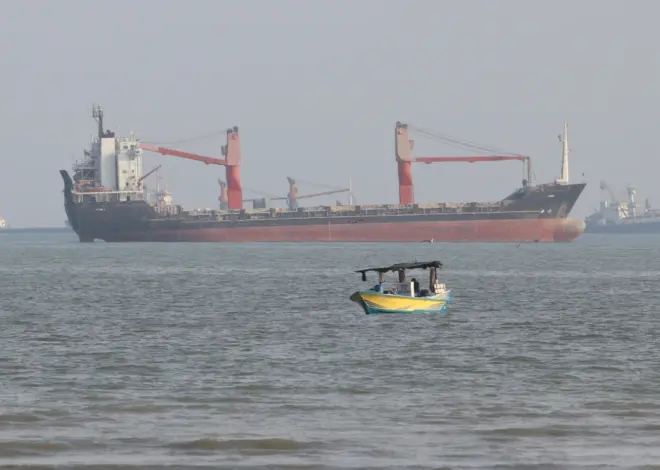
Getting oil to flow again will require the movement of thousands of tankers out of the Strait or Hormuz and Persian Gulf. Chevron CEO Mike Wirth has repeatedly cautioned that this will not be a quick or easy task.
There’s also the problem of dwindling oil stockpiles, which are being rapidly drained as the world looks to the U.S. for replacement sources of energy.
“The market has bought time, but the reality is that inventories are a lot lower,” Wirth said in an interview Friday, referring to backup sources of energy like the Strategic Petroleum Reserve.
“We’ve moved from comfortable inventories under normal times to what would soon to be uncomfortable,” Wirth told Bloomberg. “I think that’s the real question is, ‘How much longer can these measures kind of ameliorate the risk?’ At some point they may not be able to.”
Wirth suggested that efforts to offset even higher oil prices by dipping into strategic reserves could begin to lose their impact by July.
“The evidence would say you shouldn’t fully believe” any announcement of an Iran deal “until you see the agreement signed and the actions come into effect.”
Meanwhile, shipowners, insurers and vessel crews will need to be convinced that it is safe to pass through the Strait of Hormuz before full-scale maritime transit could resume.
“Even if the Strait is considered reopened, this does not automatically mean traffic will normalize immediately,” Dimitris Ampatzidis, Maritime Risk & Compliance Manager at Kpler, told NBC News.
“Vessels that have been delayed or held back would need time to exit, complete voyages, and potentially return for new loadings,” he said. “That process could take roughly 2–3 months.”
Kpler estimates that about 500 large commercial vessels are currently stuck in the region.
BIMCO, a global association of shippers, said Monday that “statements by the U.S. and Iran are currently unclear and do not offer sufficient information regarding key aspects such as timings and safe routes.”
“Due to lack of details and a history of overly optimistic reassurances, we believe the security situation for the shipping industry remains volatile,” the group said in a statement.
As recently as Friday morning, Iranian state TV said the Strait of Hormuz remained “closed until further notice.”
President Donald Trump said on social media Sunday night that the strait would be reopened after an agreement is signed with Iran later this week in Switzerland.
Read more Deadly Russian attacks fuel blaze at centuries-old monastery in Kyiv