Supreme Court justices ask Congress for additional security funding
WASHINGTON — Supreme Court justices are testifying before Congress for the first time in seven years on Tuesday, seeking additional funds to combat a rise in security threats.
Read more From The Sports Desk: Spain, France meet in star-studded World Cup semifinal
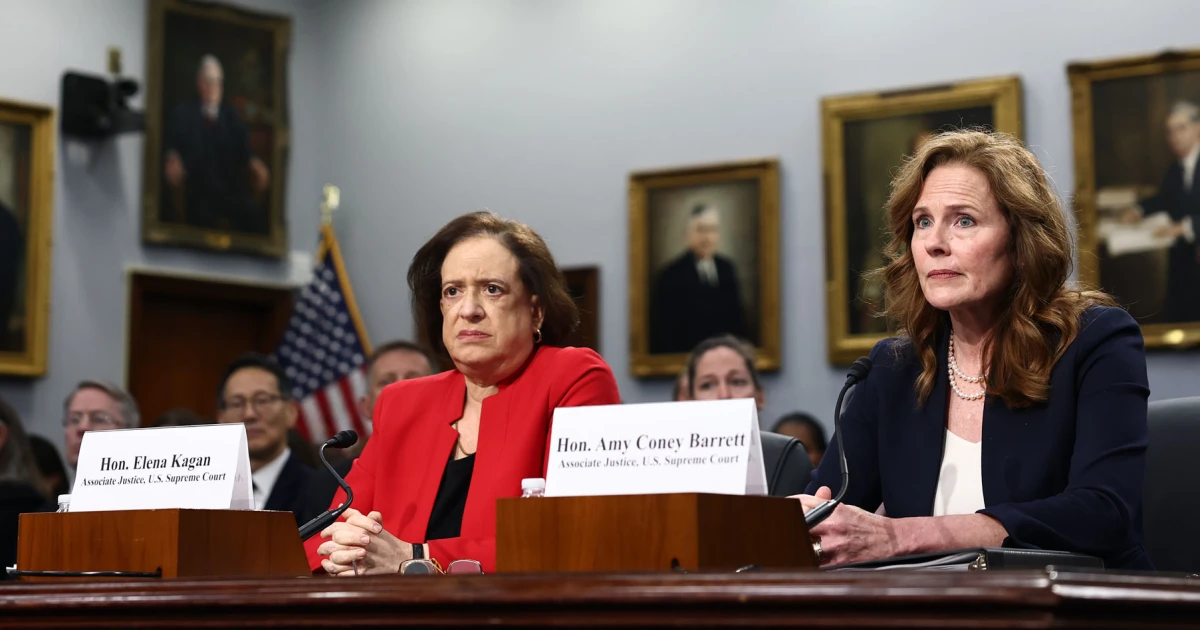
Liberal Justice Elena Kagan and conservative Justice Amy Coney Barrett are appearing at back-to-back hearings in the House Appropriations Subcommittee on Financial Services and General Government and the Senate’s version of that committee.
Supreme Court justices as well as judges throughout the federal judiciary have increasingly been the targets of threats, harassment and “swatting” incidents, in which false calls are made to police about violence at their home addresses.
Barrett herself was the subject of a swatting incident in May.
“For some of us, those threats have come very close, and all of us live with the knowledge that they may again materialize,” Kagan said in her opening remarks.
But, she added, “all members of the Court continue to do their jobs as they believe legally right, adjudicating cases without fear or favor.”
Rep. Dave Joyce, R-Ohio, who chairs the House subcommittee, acknowledged the increase in security concerns.
“Whatever one’s view of the specific Supreme Court ruling, judicial officers, up to and including the justices of the Supreme Court, must be able to do their jobs without fear for their safety or their family’s safety,” he said.
There appears to be bipartisan consensus; Rep. Steny Hoyer, D-Md., the senior Democrat on the subcommittee, agreed with Joyce’s sentiment.
“Congress must provide sufficient funding to ensure the safety of all judicial personnel,” he said.
But Democrats have also been critical of the court, which has a 6-3 conservative majority, for adopting a new ethics code that does not have an enforcement mechanism, saying that ethics lapses have contributed to a decline in public support for the institution.
The court is asking for $228.4 million, an increase of $20.5 million over the previous fiscal year. Although the Supreme Court is at the top of the federal judiciary, it is funded separately.
The Administrative Office of the U.S. Courts, which has oversight over the lower courts, is also seeking additional money for security in a separate budget request.
Read more In a sweet discovery, astronomers find sugar lurking in the space between stars
The Supreme Court’s proposed budget includes $14.6 million in additional funding for the Supreme Court’s own police department and for security at its building across the street from the Capitol in Washington.
The police department recently took on expanded responsibilities for protecting justices at their homes.
This task was previously carried out by the Marshals Service, which beefed up protection in 2022 following the leak of a draft opinion showing that the court was poised to overturn the landmark abortion rights ruling Roe v. Wade.
Another $6.5 million would be earmarked for a new visitor screening facility on the Supreme Court grounds, while $2.3 million would go toward combating cyber threats.
In total, the court predicts that it would spend $40 million on protecting justices from physical threats and $18 million on cyber threats.
The increase in threats and harassment against judges across the board has coincided with harsh criticism of judges who rule against them by prominent politicians, including President Donald Trump. Many judges have received threats through anonymous pizza deliveries to their homes — a move that has become a common tactic of intimidation.
In October, Sophie Roske was sentenced to eight years in prison after being arrested near the home of conservative Justice Brett Kavanaugh while armed with a gun.
On Monday, Capitol Police arrested a man with a gun at a barricade outside of the Capitol after he asked for directions to the Supreme Court.
Chief Justice John Roberts wrote in his that the number of threats against judges has tripled over the last decade.
There have been 370 threats against federal judges in fiscal year 2026, which began in October, according to the U.S. Marshals Service.
Justices have testified in Congress about the court’s budget regularly in the past, but Tuesday’s hearings mark the first time any member of the court has testified at a House hearing since 2019. No justice has testified before the Senate since 2011.
Read more Trump to reimpose blockade as the U.S. and Iran battle for control of Hormuz

Related Posts

New Supreme Court term begins with a climate change case seeking to hold energy companies liable
A new Supreme Court term begins with cases on climate change and gun rights