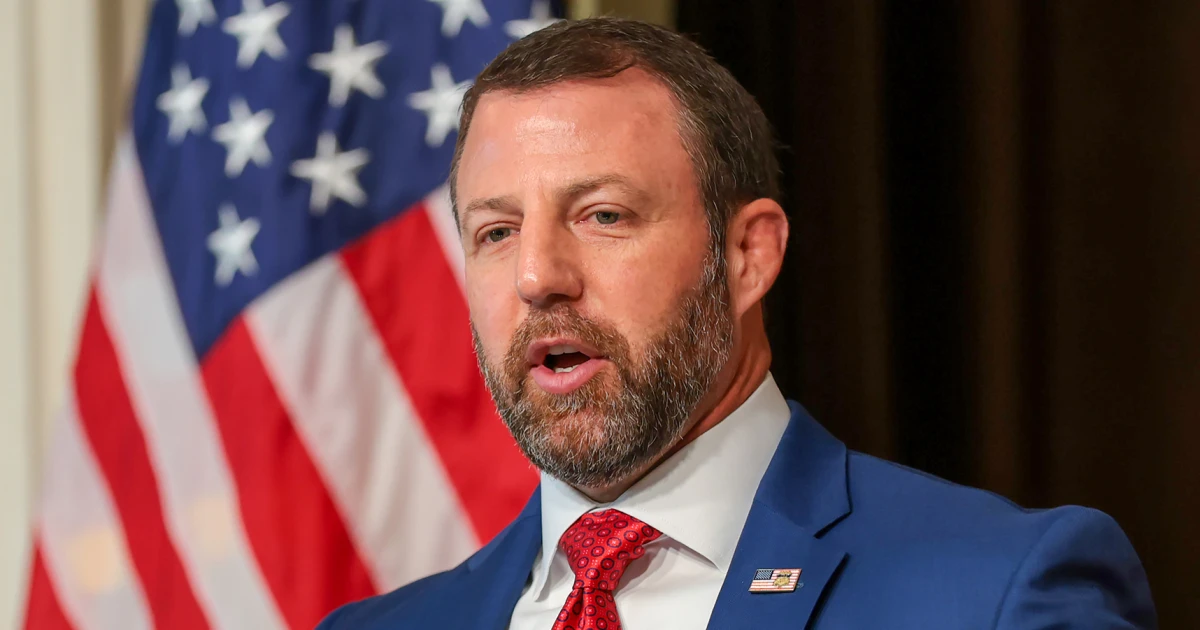
Homeland Security Secretary Markwayne Mullin threatens states over elections
WASHINGTON — Homeland Security Secretary Markwayne Mullin on Friday threatened state election officials with possible prison time if they don’t comply with Trump administration methods to determine whether noncitizens are on voter rolls.
Read more One fan’s ‘Odyssey’: A flight from Hawaii, three theaters and eight IMAX showings in 24 hours
Expanding on President Donald Trump’s election speech a night earlier, Mullin said that the Department of Homeland Security had preliminarily determined there were more than 250,000 noncitizens on voting lists in at least four states: California, New Jersey, Nevada and Pennsylvania.
Mullin demanded states run their voter rolls through a federal database maintained by DHS to determine if noncitizens were on lists and said if they don’t, they won’t be able to access federal grants.
But the use of the DHS database — which was historically for assessing immigration benefits — has been blocked by a federal judge, who ruled that repurposing it for this effort violated rules on the disclosure of Social Security records. The database has also proved to be error-prone when used to evaluate voter rolls. It often flags newly naturalized citizens as noncitizen voters. Voting rights experts say the use of the database is flawed and could result in registered voters purged from rolls.
“We need to make sure that individuals that are legally able to vote are voting,” Mullin said from the Eisenhower Executive Office Building next door to the White House. “If you’re illegal and attempted to vote, or you tried to vote illegally for someone else, we will find you and we will charge you.”
The secretary’s comments come as the Trump administration is increasingly using the levers of government to sow doubts about the nation’s electoral system as the midterm elections draw near.
“If his government had actual evidence of noncitizen voting, there would be indictments,” election law expert Rick Hasen wrote. “Trump has been hounding US attorneys to bring such cases, and the fact that he hasn’t shows that these claims likely have no legs.”
- Add NBC News to Google
The president continues to insist the 2020 election was “dirty” and “rigged,” though members of his own Cabinet publicly stated that there was no widespread voter fraud, and multiple reviews found no widespread fraud.
“We can never watch a stolen election again,” Trump said Thursday night, arguing that elections “were left vulnerable to being rigged and stolen, and the trust of the American people was lost.”
The FBI raided an elections hub in January in Fulton County, Georgia, a state Trump lost in 2020, and seized ballots. The Justice Department has sued states for voter roll data, and the department’s Civil Rights Division sent letters to election officials across the country warning of criminal penalties for knowingly retaining noncitizens on voter rolls.
Trump has also fired dozens of people from the Cybersecurity and Infrastructure Security Agency, which helps secure elections, and dismissed the remaining leadership of the U.S. Election Assistance Commission, which helps fund state elections and serves as an information clearinghouse for the nation’s more than 10,000 election administration jurisdictions.
Mullin on Friday promised that both before and after the midterms, DHS officials would be scrubbing election records looking for ineligible votes from noncitizens and from the dead.
America’s voter rolls are designed for registration and not removal, which means there are deceased voters on the rolls at any time. Election officials undergo list maintenance to update them, but that takes time.
Read more From The Sports Desk: A blockbuster World Cup Final
Mullin warned that illegal voter registration and illegal voting carry penalties of up to five years in prison and up to $250,000 in fines.
“If the election officials, once we gave them the information they need to secure their elections, and they chose not to, then those individuals can also be held accountable by fines, by penalties, and even, depending on how far it goes, prison time,” Mullin said.
Though voting rights experts say such instances of fraud happen, they are very rare, and the decentralized elections system in the U.S. is a safeguard against large-scale meddling.
Mullin also said that Trump has directed the DHS cybersecurity team to release an updated election infrastructure plan. The secretary said he will make it public within 30 days.
He said that the efforts were not part of “rehashing the 2020 election” and that “we’re not trying to change the outcome. We’re trying to make sure that American people can trust our voting system.”
Mullin said DHS found the noncitizens in the four states through their public voter rolls. Trump referenced them in his remarks at the White House, but neither stated how many noncitizens have actually voted in recent elections, if any.
Ahead of his announcement Friday, Mullin sent letters to the secretaries of state and called on them to respond within two weeks and commit to collaborating with the federal government, according to DHS.
Last year, DHS revamped the SAVE database it uses to verify individuals’ citizenship and immigration status to make it easier for state and local officials to use it to make sure voters were U.S. citizens.
It allows users to search many records at a time and gives them access to individuals’ Social Security numbers.
DHS officials insist the database itself does not make a determination that an individual is a noncitizen; it checks other government databases where proof of citizenship might be stored and flags registrants for further evaluation.
Voting rights groups argue people who were wrongly identified as noncitizens were kicked off voter rolls because the database can be outdated.
Read more NYC sightseeing chopper likely hit birds before plunging into Hudson River, NTSB finds