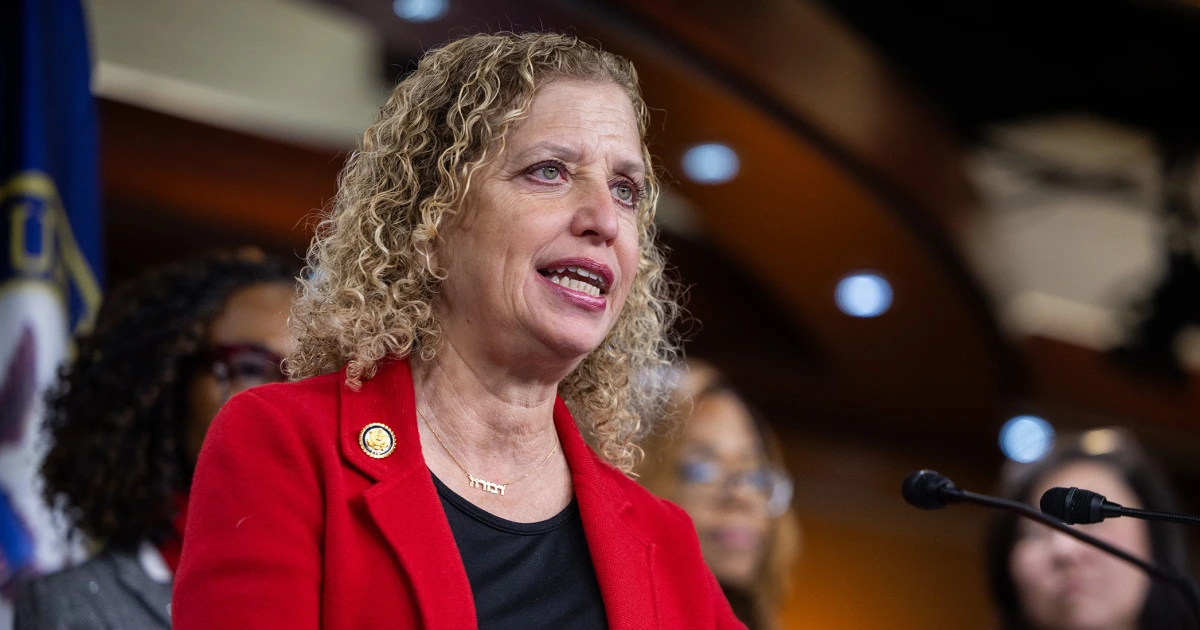
Rep. Debbie Wasserman Schultz faces backlash for running in a district long represented by Black Democrats
WASHINGTON — Rep. Debbie Wasserman Schultz is facing significant pushback from Black Democrats after deciding to run in a newly redrawn district in South Florida that has a plurality of Black voters and a crowded primary field.
The Florida political landscape was scrambled after Gov. Ron DeSantis signed legislation last month creating new congressional maps. Instead of running in the 22nd Congressional District, where she lives, Wasserman Schultz opted to run in the more Democratic-leaning 20th District, which has long been represented by a Black Democrat.
But the move has angered Black leaders and candidates in that district, especially coming at a time when Republicans have attempted to wipe out districts long held by Black Democrats after a recent Supreme Court decision that limits the consideration of race in drawing up congressional maps.
Four Black candidates running in the primary have even discussed coalescing around one or two candidates in order to take on Wasserman Schultz rather than split the Black vote, according to one of the participants in the meeting.
Wasserman Schultz, an 11-term incumbent and former chair of the Democratic National Committee, announced her decision last month, saying she wanted to ensure her seniority would not be lost.
Wassmern Schultz argued that if Democrats take control of the House, she would be in line to chair a key congressional committee, which would be good for the district.
“You have always been able to count on me to deliver results for our community,” she said in a video announcing her decision to run, which emphasized her “seniority and “clout” announcing her decision to run.
House Minority Leader Hakeem Jeffries, D-N.Y, who would be in line to become the first Black speaker if Democrats take control of the House in November, told reporters Tuesday that he has not yet decided if he was endorsing in the race.
“Haven’t made a decision as it relates to that particular race,” said Jeffries, who normally as caucus leader would be expected to support an incumbent.
Asked by NBC News Wednesday about Jeffries declining to endorse, Wasserman Schultz said, “He didn’t say that,” before quickly walking into the Democratic cloakroom and onto the House floor.
She later issued a statement to NBC News saying she is “thankful” for the support she is receiving.
“I’m thankful for the strong broad support I’ve received all over CD20,” she said. “I’ll continue to talk with Broward voters and make my case that I’ll be the most effective representative for this whole community, and as always, I’m not taking any support for granted.”
Black Democratic members of Congress have been critical of her decision.
“If I were in her shoes, I can’t say. … Actually, I do know what I would do,” Rep. Jasmine Crockett, D-Texas, said Wednesday. “I wouldn’t do it if I was her, but I’m not her. Because everybody has their reasons for why it is that they want to do what they want to do.”
“But I think that there are people that are very concerned, especially with the Black Caucus continuously being under attack,” she added.
Wasserman Schultz’s decision to run for Black plurality seat has also been greeted with almost universal scorn from Black Democrats in Florida.
“I would not have expected the call would come from inside the house,” said Elijah Manley, a teacher and activist who was the first to enter the primary race for the district’s seat. “I didn’t think a white Democrat would be the one to take away a Black seat.”
Other Black Democrats in the race include rapper Luther “Luke” Campbell and former Broward County Mayor Dale Holness.
Manley has raised $780,000, the most money aside from Wasserman Schultz, who has raised $2.5 million through March, giving her a commanding financial advantage over the rest of the field.
Florida’s 20th Congressional District has been represented by a Black Democrat for nearly 30 years.
Read more Artist suing FIFA over destruction of Dallas whale mural before World Cup
The seat has no incumbent after Rep. Sheila Cherfilus-McCormick, D-Fla., resigned in April after the House Ethics Committee found her guilty of ethics violations related to allegations she stole federal relief fund and used some of that money to fuel her political campaign.
Cherfilus-McCormick, who is also facing federal indictment, is again running for the seat in 2026.
Campbell released a video in May, before Wasserman Schultz made her decision, warning her not to get in the Black plurality seat.
“If her strategy is to come in because there are multiple Black candidates and hope we ‘split the vote’ … that’s the same old playbook — divide and conquer,” he said.
The idea of consolidating the field and backing just one or two candidates was openly discussed among those candidates during a Monday meeting. No decision was made, but there the idea of getting a head-to-head matchup with Wasserman Schultz was openly discussed.
“We agree on principle that there needs to be consolidation that increases chances of beating her head-to-head,” Manley said. “We need to do everything we can to bring the number of candidates down.”
A South Florida Black Democratic elected official, granted anonymity to speak freely about the consolidation plan said, “let’s just hope egos do not get in the way.”
Holness told NBC News on Wednesday that he provided Wasserman Schultz polling data that showed she could win Florida’s 22nd Congressional District, and urged her to run for that seat.
“It is disappointing that she was not sensitive to the call by many in the community,” he said. “I actually gave her polling data that showed she could win 22. At the time, there were not candidates in the race on the Democratic side.”
He said during the meeting about consolidating the race, everyone believed that if the field did not change, Wasserman Schultz would win the race.
“That was the consensus in the room,” said Holness, who said if data suggested there were a stronger candidate than him, he would consider not running.
He said a decision on consolidation could come as early next week.
Wasserman Schultz has previously implied that the Congressional Black Caucus did not oppose her run when she had discussions with the group.
“They know I know our community,” she told CBS News’ Miami affiliate in late May.
Congressional Black Caucus Chair Yvette Clarke, D-N.Y., said Wasserman Schultz had approached her on the House floor before the Memorial Day recess and informed her she was running in the new district, and that her decision has caused “consternation.”
“It was more information than it was a conversation. Conversation is discourse, right? It was informational,” Clarke told reporters Wednesday. “I said, ‘Well, thanks for informing me.’”
And she defended Jeffries choosing not to get involved.
“It’s a new district; there is no incumbent,” Clarke added.
The CBC as an organization has not publicly chimed in on Wasserman Schultz’s decision beyond Clarke comments. The group did not respond to a request seeking comment.
In the 20th Congressional District, which is wholly contained in Broward County, Black residents make up 50% of the voting pool in the Democratic primary. The fact that the district was drawn in a way to perform well for Black Democrats is the reason Wasserman Schultz is receiving huge backlash.
“At a time when aggressive redistricting has already weakened minority voting strength across Florida, the preservation of Black political representation is not optional,” the Democratic Black Caucus of Florida said in a statement. “It is essential.”
Read more Man found with zip ties and duct tape charged with assaulting 5 women at UCLA

Related Posts

James Talarico and Ken Paxton hold a day of dueling rallies as Texas begins early voting
Mike Rogers bets he can outflank Abdul El-Sayed with a low-key campaign in Michigan’s Senate brawl